
Direction Beats Effort
6 Lessons from Pete Steege on Why Working Harder Stopped Working

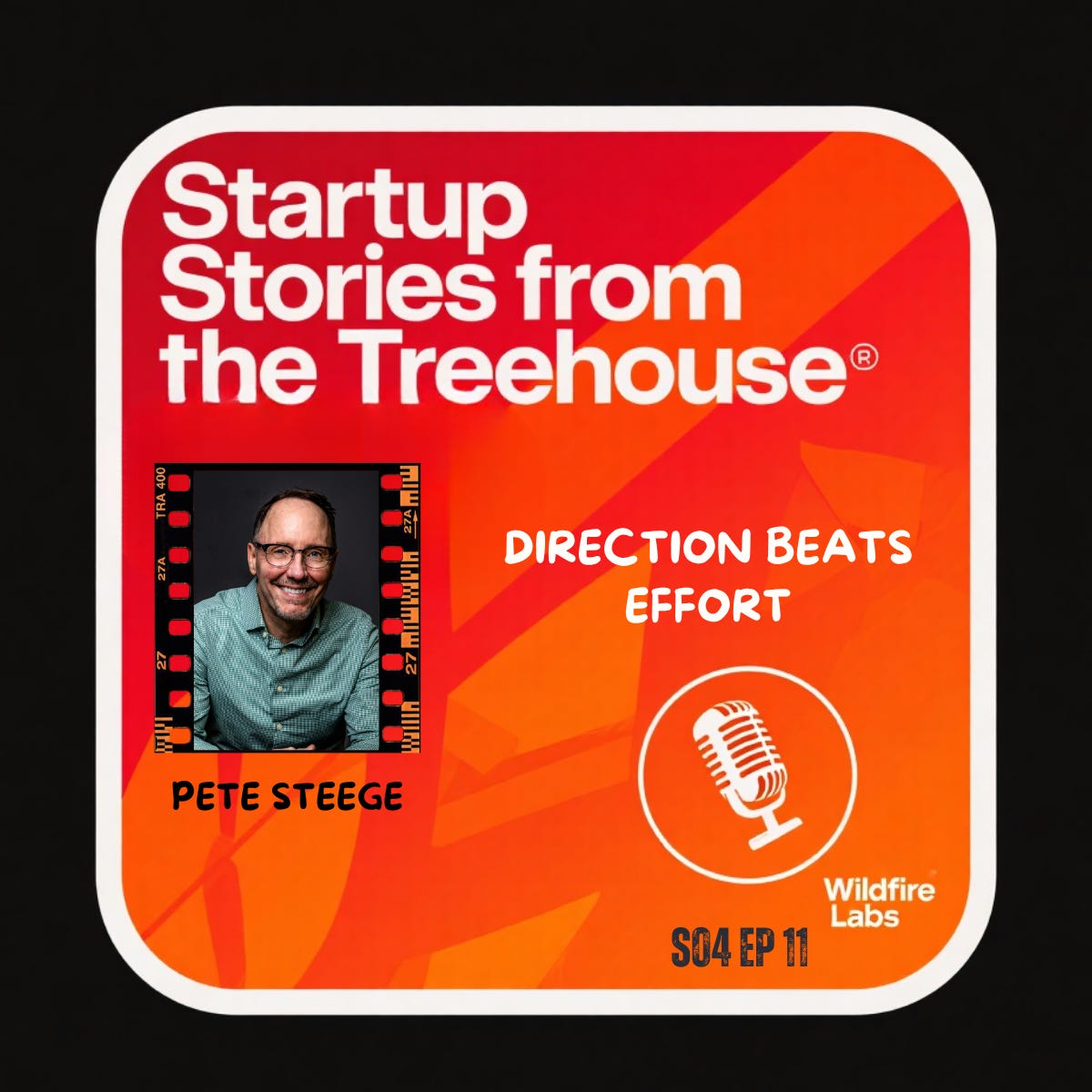
Most technical founders are stuck doing more. More ads, more hires, more campaigns, more meetings. And getting less back than they used to. Pete Steege spent 30 years inside companies watching that strategy stop working. Here’s what helping CEOs of $10–100M B2B tech companies has taught him about why the constraint quietly moved from effort to direction.
I recently sat down with Pete Steege on the podcast. Pete started as a semiconductor engineer at IBM, did stints in Germany and Japan, ran global marketing for Seagate and Code42, and in 2020 founded B2B Clarity to help technical founders unstick their companies. He’s written two books on the subject. On Purpose came out in 2022, and Radical Clarity followed in 2025.
What struck me was how directly he names the kind of stuck most founders won’t say out loud. The technology works. The customers are real. The team is capable. And yet something is off. Pete has a name for that, and a framework for fixing it. If you’ve been working harder and getting less in return, these lessons are for you.
Direction Is the New Constraint
Pete has a line that’s been rattling around in my head since I first read it: “Effort is no longer the constraint. Direction is.”
Twenty years ago, the founder who out-worked the room won. The cost of effort was real. Doubling output meant doubling headcount, hiring agencies, building infrastructure. Now? AI writes the copy. Tools automate the ops. Distribution is a credit card. The bottleneck moved.
The founders I see stuck at $2M, $5M, $15M aren’t lazy. They’re working harder than they ever have. They just aren’t sure which “more” matters anymore. Pete’s diagnosis is that effort can no longer save you from a lack of direction. Pour another $50K into ads. Hire another SDR. Refresh the website. If your direction is wrong, you’ll get further from the answer faster.
What to do this week: Pick the three things on your calendar taking the most time. For each, ask: if this works exactly as I hope, does it move me toward what matters? If you can’t answer cleanly, you have a direction problem, not an effort problem.
You’re Probably an Accidental CEO
“Accidental CEO” is Pete’s phrase and it lands on the right people. The accidental CEO is the technical founder who became chief executive without a roadmap for the leadership side. They built the product. The customers showed up. Investors followed. One day they looked up and they were running a company. Leadership, marketing, hiring, strategy decisions. And nobody handed them a manual.
I had this exact conversation with a founder at WildFire last month. Brilliant engineer, $4M ARR, growing 80% year over year, visibly exhausted. The problem wasn’t the product. The product was great. The problem was that he’d been making leadership decisions in fifteen-minute gaps between bug fixes for two years, and nothing got the time it deserved. He told me, “I keep waiting for the part where this gets less lonely.” That’s the accidental CEO talking.
Pete’s whole point is that this happens to almost everyone, and pretending it isn’t happening to you is the actual problem. The first step to running the company you built is admitting you didn’t sign up for half the job. Pete put together a free self-assessment for exactly this called the Accidental CEO Audit. If this section landed, that’s twenty minutes well spent.
What to do this week: Block ninety minutes on your calendar, alone, for one question: what leadership decision have I been avoiding because I’d rather solve a technical one? Write it down. That’s the work.
Your Marketing Problem Is a Clarity Problem
Pete has a framework he calls CMP. Clarity, Meaning, Purpose, Action. Most founders skip straight to action. They want the new website, the better deck, the LinkedIn campaign, the rep hire. Pete argues that almost every problem framed as a marketing problem is a clarity problem in disguise. You can’t write a better landing page if you don’t know who you’re for, what’s true about why they buy, and what you specifically do that nobody else does.
I’ve seen this pattern too many times to count. Founder spends $30K with an agency on a brand refresh. Six months later, conversion hasn’t moved. The agency did good work. It couldn’t compensate for upstream confusion the founder hadn’t done the painful work of resolving.
Marketing is downstream of clarity. Skip the upstream work and you’ll spend the year buying expensive proof that you skipped it.
What to do this week: Write down, in one sentence each: who you serve, what you do for them that nobody else does, and what evidence you have that they want it. If any of those feel hand-wavy, your next move isn’t more marketing. It’s more clarity.
Pick a Bullseye, Not a Target
Pete distinguishes between a “target customer” and a “bullseye customer.” A target is the broad group you’re aiming at. A bullseye is the customer at dead center. Narrow enough to name three real companies that fit. Tight enough that everything you say is recognizably for them.
This is where Pete and I agree completely, and where most founders flinch. Going narrow is operationally correct and strategically terrifying when you’re pitching investors. “My TAM is the global enterprise software market” raises money. “My TAM is mid-market manufacturers with 200–500 employees and a quality control problem” raises questions.
Pete doesn’t see the bullseye and the TAM story as conflicting. You go bullseye to get traction. You use that traction to prove out the bigger story. You don’t get to skip step one. Founders who try end up with positioning so generic nobody picks them, and a sales cycle that confirms it.
What to do this week: Name three real companies, by name, that you’d bet money are an exact fit for what you sell. If you can’t, you don’t have a bullseye yet, and your sales math is going to keep being off.
Most Human Wins (And Where I Push Back)
Here’s where Pete and I split. Pete’s position is that as AI floods the content landscape, most human wins. The scarce resource isn’t more output. It’s authenticity. The founder writing one honest LinkedIn post a week from their own perspective beats the company pumping out three AI-generated thought leadership posts a day.
My instinct is the other side. AI with bad rails produces slop. AI with good rails produces work that scales the founder’s voice instead of replacing it. By “good rails” I mean strong personas, domain expertise, tight style guides, and the founder’s real subject-matter knowledge as input. The Substack you’re reading right now goes through that exact loop. I write the point of view. I let the tools amplify it.
Where we agree: the pure “more output” play is dying. The founder using AI as a force multiplier on a real point of view will lap the founder pumping out slop and the founder refusing to use the tools at all. The losers are the people in the middle.
What to do this week: Pick one piece of content. Write it yourself, in your own voice, no AI. Then pick a second piece. Use AI from a real outline, real examples, and a real opinion you wrote down. Compare. The answer for your business is in the comparison.
Institutionalize the Magic
Pete writes about “institutionalizing the magic” of the founder. The idea is to capture what makes them uniquely valuable so the company can scale it. My pushback, which I asked him directly: a lot of founders’ magic IS them. Their story, credibility, personality. Institutionalize it and you risk killing the thing that worked.
Pete’s reframe: the goal isn’t to replace the founder. It’s to capture the parts of what the founder does that the company can scale, so the founder is freed up for the parts only they can do. The founder who hand-writes every sales email and personally reviews every piece of content is a bottleneck dressed up as authenticity. The version of the company that survives the founder taking a real vacation is the version worth building.
Here’s the version I’ve watched at WildFire. One of my founders used to write every customer QBR himself. Five hours a week, every week, because “nobody else understands the customer.” We sat down, mapped the structure of his best QBR, and turned it into a 1-pager any account manager could follow. Six weeks later, he wasn’t writing them, and the customer satisfaction scores went up. The structure was tighter than what he’d been freelancing every Sunday night.
What to do this week: Pick one thing you do every week that someone else theoretically could. Write down the operating principle behind how you do it. Hand it to one person. See what happens.
The Bottom Line
Effort used to be the moat. It isn’t anymore. The founders who win the next five years will be the ones who pick a direction, hold it, and stop confusing motion for progress.
What direction have you been avoiding looking at because you already suspect the answer?
This article is based on my conversation with Pete Steege on the podcast. We covered a lot more than I could fit here. His arc from IBM semiconductor engineer to global marketer. His time launching products in Japan. Why the $10–100M range is where the accidental CEO problem hits hardest. And how his thinking evolved between On Purpose and Radical Clarity.
[Listen to the full episode here.]
[Link for the landing page here.]
Pete also put together a page of free resources for Treehouse listeners, including the Accidental CEO Audit, bonuses for his new book Radical Clarity, and a way to book a clarity call with him directly.
Connect with Pete: b2b-clarity.com | LinkedIn |Radical Clarity | On Purpose
Thanks Sheo for the comment and the Alice and Wonderland reference. That is great. The real star of this article was Pete Steege. Worth checking out the podcast as it has even more nuggets. Thanks again
MR.TODD once again shares deep insights in his Thought-Provoking post—Direction Beats Effort—he questions —What direction have you been avoiding looking at because you already suspect the answer?—and,MR.TODD answers —6 Lessons from Pete Steege on Why Working Harder Stopped Working—Effort used to be the moat. It isn’t anymore. The founders who win the next five years will be the ones who pick a direction, hold it, and stop confusing motion for progress.
What An Illumination on Direction ! What A Direction ! MR.TODD is A GENIUS !
MR.TODD post reminds me of few lines by Lewis Carroll, Alice in Wonderland:
Alice: Would you tell me, please, which way I ought to go from here?
The Cheshire Cat: That depends a good deal on where you want to get to.
Alice: I don't much care where.
The Cheshire Cat: Then it doesn't much matter which way you go.
I compliment MR.TODD on the EXCELLENT Post and after reading,RE-READING I’m convinced that the key to better results isn’t working harder. Most of us already work long hours. The problem is we don’t always work smart.
It’s natural to think that people who get better results than us are simply putting more efforts. And,MR.TODD corrects us that it’s not true.
MR.TODD WISELY concludes that what seems like a difference in efforts often comes down to a difference in DIRECTION !
direction ! Direction ! DIRECTION !