
Find Your Pump Handle: John Snow’s Map and the Founder’s Field Guide to Product Truth
A founder’s framework: 20 conversations, one visual map, and a single change that proves (or kills) your thesis.

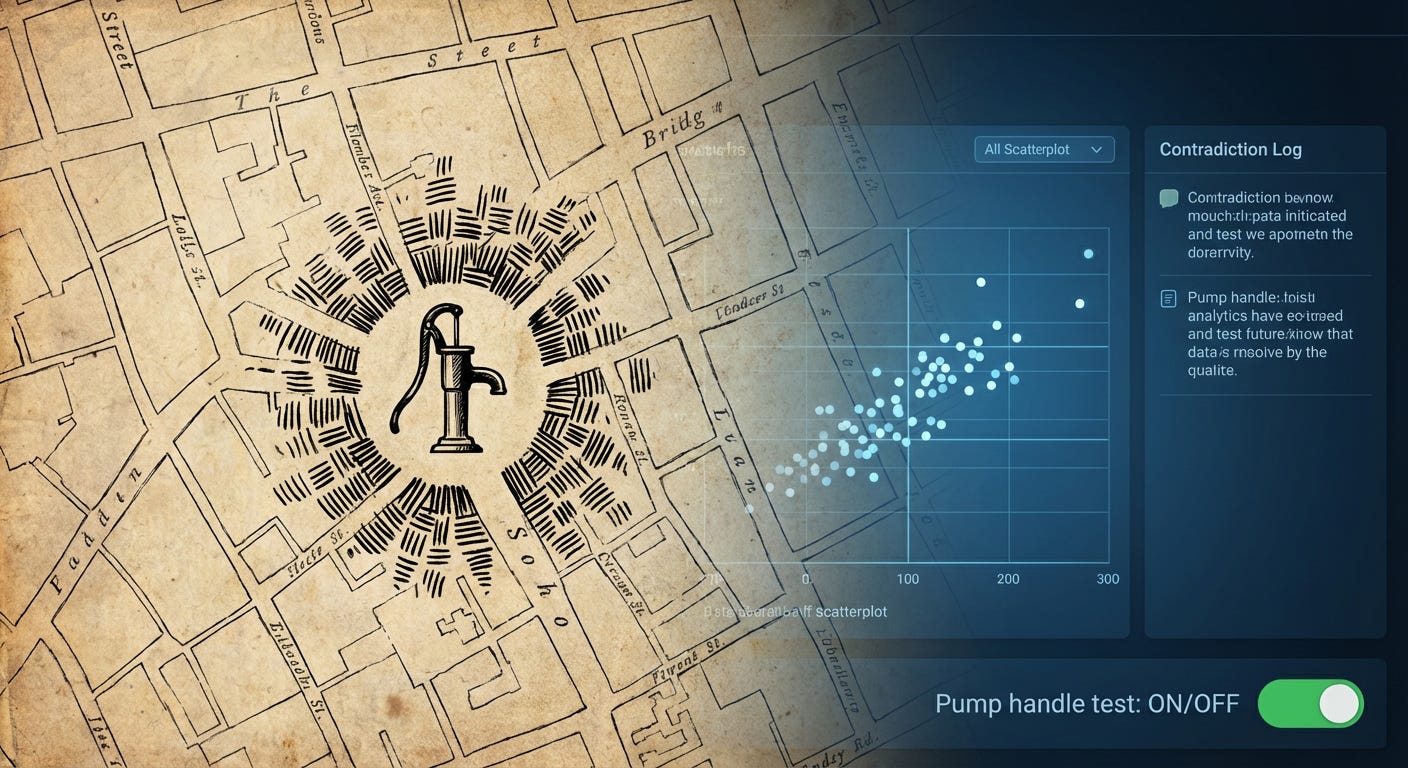
In August 1854, the Soho district of London is in decline. In three days, 127 people on Broad Street have collapsed, turned blue, and stopped breathing. Cholera moves fast—a victim can be healthy at breakfast and dead by dinner. Residents who can afford to flee have left. Those remaining stuff rags under their doors and burn vinegar, hoping to purify the air they believe is causing their suffering.
The city’s medical establishment knows the cause: Miasma, bad air from the ground carrying disease. Every credible authority endorses the centuries-old theory. Poor neighborhoods smell terrible and have more sickness—the connection is clear. The science is settled.
John Snow, a local physician, disagrees. He suspects cholera spreads through contaminated water, not air. But suspicion isn’t proof. While London’s leading doctors debate atmospheric conditions from their offices, Snow walks into the outbreak zone and starts knocking on doors.
Before we follow him through those streets, we need to understand his challenges.
The Consensus Problem
Miasma theory wasn’t fringe; it was the public health operating system. London’s infrastructure, medical training, and government policy assumed it. Challenging miasma meant challenging everyone with credentials and authority.
The theory persisted because it was partially true. Poor neighborhoods smelled terrible and had more disease. The correlation was real; only the causation was wrong. Intelligent people believed it because the pattern matched their observations.
Every market has its own miasma theories—assumptions so embedded that questioning them feels naive. “Consumers won’t pay for privacy.” “Enterprise sales require a field team.” “This demographic doesn’t adopt new technology.” Consider how long “enterprise software requires direct sales” persisted even as Slack grew to over 150,000 paying organizations by 2021 and Figma landed contracts at Microsoft—significantly aided by bottom-up, product-led adoption (among other factors like security and admin controls) rather than traditional field sales. These beliefs persist because they’re partially true, were true once, or hold for some segments. They get repeated at conferences, absorbed by founders who never verify them.
The danger isn’t that conventional wisdom is always wrong. It’s that founders treat it as settled science when it is actually untested consensus.
Snow’s Method
Snow entered an outbreak while his peers theorized from safety. He knocked on doors, talked to survivors and grieving families, and asked the same questions: Where did you get your water? Where did the deceased get theirs?
He noted specifics: addresses, dates, sources, and irregularities.
A Broad Street brewery gave workers a daily beer allowance. They rarely drank local water. Virtually none were dying. A woman in Hampstead, miles from Soho, died of cholera with no apparent outbreak connection. Snow discovered she’d lived on Broad Street and loved its pump water—she had it delivered to her new home. Her niece, who shared the water, also died. No one else on her street was affected.
Brewery workers who avoided the water largely survived. The woman who sought out the water died. The air was the same. The water was different.
Snow plotted every death on a map. They clustered around the Broad Street pump like iron filings around a magnet. What was invisible in notebooks became undeniable on paper. Later investigation revealed the cause: a cesspit near the pump leaked sewage into the well.
Snow didn’t have better technology than his peers. He had better methodology. While miasma believers debated theory, he gathered evidence. The map wasn’t extraordinary—it was the inevitable output of doing work others considered beneath them.
The Founder Translation
Snow’s method maps directly to customer discovery, but with a critical difference: the intense focus on anomalies.
Most founders do customer interviews for confirmation. Snow looked for contradiction. The brewery workers should have died but didn’t. The Hampstead woman shouldn’t have died but did. These anomalies weren’t noise—they were the complete signal.
When Airbnb’s founders couldn’t understand why New York listings weren’t converting, they flew there and visited hosts. They discovered the photos were terrible. That anomaly—good listings with bad photos—revealed the intervention that unlocked growth. When Figma was developing collaborative design tools, the team watched designers work. They noticed they emailed files back and forth even when using collaboration tools. The anomaly revealed the real problem.
The standard advice is “talk to customers.” The Snow method is more specific: document every case, especially the ones that challenge your mental model. The customer who should love your product but doesn’t. The one using it in unintended ways. The competitor who keeps coming up. If you’re not finding anomalies, you’re not looking hard enough or unconsciously filtering them out.
Before your discovery sprint, write down your three core assumptions as a practical safeguard. During interviews, note evidence against those assumptions. Before synthesizing, review the log. This prevents the tendency to remember only what supports your thesis.
Synthesize visually. The map was convincing; Snow’s notes weren’t. Create an artifact—a journey diagram, a 2x2 matrix, or a simple chart—that makes your insight clear without lengthy explanation. A useful threshold: the same unexpected pattern appears in at least three independent conversations across different segments. If you can’t visualize your discovery, you might not have discovered anything.
In remote or regulated contexts, the “street” looks different but exists. Screen-share sessions watching users struggle, recorded sales calls with clustered objections, and ride-alongs with field teams are all part of it. Proximity can be virtual if it’s direct observation, not survey data.
The Pump Handle
Here’s the part that doesn’t make it into inspirational versions: Snow presented his findings, and the local board removed the Broad Street pump handle. The outbreak subsided—but it was already declining. Critics claimed his intervention proved nothing. The official investigation acknowledged a possible connection but attributed the outbreak to miasma. Snow died four years later without seeing his theory accepted.
Being right wasn’t enough. Institutions have defenses. Paradigm shifts take decades.
But Snow achieved something crucial: one pump handle removed long enough to matter. He didn’t convert the medical establishment. He convinced one local board to take action. That’s the minimum viable paradigm shift.
You’re not trying to win an academic debate. You’re trying to build something that works. Forget converting the whole market. Find one customer, one decision-maker, one pump handle where your insight makes a difference.
How do you identify your pump handle? Four criteria: it tests your biggest assumption; you can execute it within two weeks with current resources; it’s reversible with a low blast radius if you’re wrong; and the outcome is clear enough to know if it worked.
Two examples: Superhuman believed a mandatory 30-minute onboarding call would improve retention despite common belief that it would harm conversion. They compared cohorts with and without the requirement; the call cohort retained dramatically better. One intervention answered a question that could have been debated indefinitely. In a different domain, a logistics startup suspected drivers’ biggest pain wasn’t pay rates but unpredictable wait times at loading docks. Instead of rebuilding their app, they tested sending SMS alerts with estimated wait times to one driver group. Satisfaction scores jumped; turnover dropped. The pump handle revealed the real problem wasn’t compensation—it was uncertainty.
Your Discovery Sprint
A four-week plan:
Week one — identify 20-30 people in your target segment, including skeptics, competitors’ customers, and those who tried and failed. Focus on breadth, not confirmation. For enterprise contexts, 10-15 deeper conversations may be more realistic; triangulate across buyers, users, and operations.
Week two — conduct 15-20 conversations. Don’t pitch. Ask: “Walk me through the last time you dealt with this problem.” Document exact quotes. Tag anomalies explicitly—maintain a running list of “things that don’t fit my model.”
Week three — cluster what you heard. What patterns emerge? What surprised you? Build a visual artifact that makes the pattern clear to a skeptic.
Week four — identify your pump handle. Run one small, reversible, low-blast-radius intervention.
The output: “I talked to X people and learned Y, contradicting the assumption that Z.” If you can’t complete that sentence, you haven’t put in the effort.
Sometimes the map confirms consensus, which is valuable—you’ve converted assumption into knowledge. The failure is not discovering that conventional wisdom is right, but never testing it.
The Untapped Map
Snow could have stayed comfortable, trusted consensus, and treated patients within the accepted framework. Instead, he walked into an epidemic, knocked on doors, and built a map that became a founding document of epidemiology. The cesspit leak he helped expose was fixed. His methodology saved countless lives—even though he never saw his theory validated.
There’s a pump handle—an insight that could change everything. You won’t find it from your desk, industry reports, or investor feedback.
Twenty conversations. One map. Find your pump handle.
_________
Did this post resonate with you? If you found value in these insights, let us know! Hit the ‘like’ button or share your thoughts in the comments. Your feedback not only motivates us but also helps shape future content. Together, we can build a community that empowers entrepreneurs to thrive. What was your biggest takeaway? We’d love to hear from you!
Interested in taking your startup to the next level? Wildfire Labs is looking for innovative founders like you! Don’t miss out on the opportunity to accelerate your business with expert mentorship and resources. Apply now at Wildfire Labs Accelerator https://wildfirelabs.io/apply and ignite your startup’s potential. We can’t wait to see what you’ll achieve!
It looks like the map didn’t actually help much with the discovery: https://www.researchgate.net/publication/12425995_Map-making_and_myth-making_in_Broad_Street_The_London_cholera_epidemic_1854
MR.TODD always without hesitation tells What’s harder - Find Your Pump Handle—by intense focus on anomalies—that’s the work of Reflection.
MR.TODD article reminds me of Michelangelo who said—"Trifles make perfection, and perfection is no trifle." MR.TODD’s insights of real life lessons from John Snow’s Map and the Founder’s Field Guide to Product Truth rightly emphasize that meticulous
discovery of that single change that proves (or kills) a startup’s thesis.
MR.TODD excels in creating playbook as is deeply rooted in the founder’s framework: 20 conversations, one visual map, and that life-altering change.
MR.TODD convinces me that the ability to delay action until the question is clear and to conserve attention for what actually matters is key to leverage and I’m going to apply it right away. It teaches me not to sprint but to sit still to see the terrain.