
Mastering Uncertainty: The Two Types of Startup Challenges
Why some problems need planning and others need experiments - and how to tell the difference

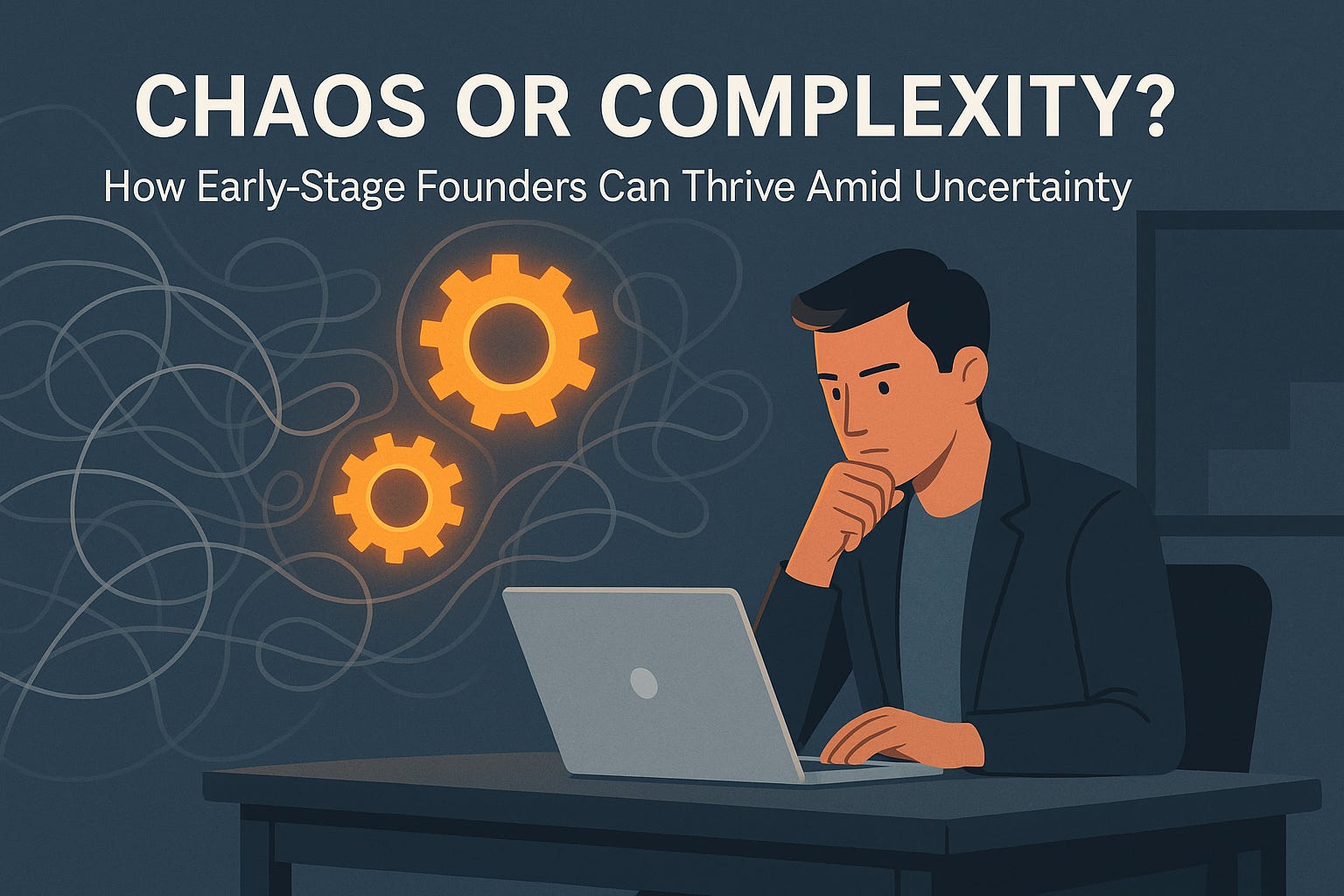
The 3 AM Founder Spiral
It's 3 AM. You're staring at the ceiling, your mind racing through problems. Yesterday's key customer threatened to leave. Your engineering team discovered a critical bug in your latest release. Investors want metrics you hadn't considered tracking.
Each week, you feel less like a visionary and more like a firefighter. You race from one crisis to another, wondering if you're missing something essential about running a startup.
Most founders don't realize that they're not bad at running a business. They're confusing two fundamentally different environments that require different approaches.
Some challenges are merely complicated—difficult but predictable and solvable through expertise and careful planning. Others are genuinely chaotic—inherently unpredictable and requiring a different mindset.
Learning to distinguish these environments transformed my founder journey from anxiety to strategic clarity. It will do the same for you.
How I Learned This Lesson the Hard Way
After raising a $2.5 million seed round for my B2B SaaS platform, I had a team of 14 skilled engineers and product specialists building a compliance automation tool for financial services firms based on customer needs.
Despite our expertise and an 18-month product roadmap, we kept getting blindsided. Unknown competitors emerged with different approaches. Regulatory changes forced constant pivots. Features customers requested during interviews went unused.
Our burn rate hit $180,000 monthly while revenue stalled at $27,000. With 14 months of runway remaining, the pressure was intense.
The turning point came after a disastrous product launch. After we spent $320,000 and four months developing an advanced reporting module requested by our top five customers, adoption after six weeks was zero. In our post-mortem, my CTO made an observation that changed everything: "We're treating unpredictable human behavior like it's a math problem."
That insight sparked a complete shift. Instead of building for months based on customer feedback for our next feature, we created three prototypes and put them in front of users within two weeks. We measured usage, adjusted quickly, and had a winning feature in market within a month—one-eighth the cost.
In two quarters, our revenue jumped to $89,000 monthly while our burn rate decreased to $145,000. My sleep quality improved from 4.5 to 6.5 hours nightly (measured on my Oura ring). This was not because we eliminated uncertainty, but because we stopped fighting it with ineffective tools.
Complicated vs. Chaotic: Understanding the Difference
The distinction is clear and powerful:
Complicated environments have many moving parts but follow predictable patterns. They are intricate, like a car engine or computer code, but with the right expertise and analysis, outcomes are predictable. The same input reliably produces the same output.
Chaotic environments are unpredictable. They're sensitive to initial conditions, making precise forecasting impossible, like weather systems or stock markets. The same input can produce vastly different outputs.
Building your product is complicated. Predicting market response is unpredictable.
Understanding this distinction isn't merely academic. It changes how you approach problems, allocate resources, and maintain your sanity as a founder.
Startup Examples: When Founders Misstep
Consider these typical scenarios:
Treating the complicated as chaotic: A fintech founder with an 8-member team viewed their engineering challenges as mysterious and unpredictable, creating constant anxiety. After her team missed three release deadlines, burning $140,000 in additional costs, she implemented proper documentation, clear sprint structures, and brought in an experienced technical lead. Delivery became predictable within two cycles. What seemed chaotic became merely complicated—difficult but manageable.
Treating chaos as complicated is common and dangerous. Kiran, founder of a D2C wellness brand, launched a marketing campaign with precise ROI predictions based on industry benchmarks, allocating $85,000 across channels with expected 3.2x returns. The actual results varied—some delivering 7x while others barely broke even—for reasons his marketing team couldn't explain. Instead of accepting the unpredictability, Kiran demanded more detailed analysis and planning. He spent an additional $30,000 on consultants before shifting to an experimental approach with multiple parallel $5,000 tests.
I watched another founder, Sarah, spend six months and $200,000 developing a "perfect" pricing strategy for her healthtech platform based on competitive analysis and customer interviews with 87 potential users. When she launched, customer behavior was unexpected—the carefully crafted mid-tier option that 72% of interviewees wanted was ignored in favor of the basic plan that only 18% liked.
Sarah's competitor took a different approach. They launched three pricing structures simultaneously to 500-user segments, measured real purchase behavior, and had a market-validated strategy within three weeks at a cost of $27,000. Six months later, they captured 23% market share while Sarah's company struggled at 8%.
The difference wasn't intelligence or expertise. It was recognizing that customer pricing behavior is unpredictable and requires experimentation rather than prediction.
The Hidden Benefits of Embracing Chaos
Beyond avoiding mistakes, distinguishing chaos from complexity offers significant advantages:
Increased psychological safety: When teams understand certain outcomes are unpredictable, failure becomes a learning source rather than blame. Apex Software saw employee retention improve from 62% to 84% annually after labeling market experiments as "chaotic-environment learning" instead of "success/failure." Their Glassdoor rating increased from 3.7 to 4.6 in six months.
Enhanced decision speed: Teams waste less time predicting the unpredictable. MediTech reduced their go-to-market decision cycle from 67 to 24 days by categorizing decisions as requiring detailed analysis (complicated) or rapid experimentation (chaotic). This acceleration allowed them to test three times more market hypotheses quarterly, identifying a significant feature that competitors missed.
Better investor relationships: Founders who clearly articulate which aspects of their business are predictable versus unpredictable demonstrate strategic thinking. When Claire pitched her Series A round, she separated her deck into "operational projections" (with detailed metrics) and "market hypotheses" (with multiple scenarios and testing methodologies). She raised $5.2M on better terms, and two investors cited her "dual framework" approach as a key factor.
Founder mental health: This framework reduces the anxiety of needing to predict everything. When Victor implemented it at his 23-person startup, his weekly founder anxiety score (self-rated 1-10) dropped from 8.2 to 5.7 within a month, while his leadership effectiveness rating from team members increased by 31%.
Practical Strategies for Different Environments
Here's how to adapt your approach based on the situation:
For Complex Challenges:
Invest in expertise and specialized knowledge.
Create detailed documentation and clear processes.
Emphasize careful analysis before action.
Set specific metrics and expected outcomes.
Delegate to technical experts with assurance.
For Chaotic Challenges:
Prioritize speed and iteration over perfection.
Run multiple small experiments instead of one large bet.
Shorten feedback loops to days, not months.
Measure actual behavior, not expressed preferences.
Instead of relying on single forecasts, develop scenario planning.
Cultivate psychological safety around "successful failures."
The most practical immediate step is to categorize your current challenges as complicated or chaotic at your next team meeting. This will clarify strategies and reduce team frustration.
Recognizing Environmental Changes
Environments aren't static. Today, what's chaotic may become complex tomorrow:
Customer acquisition starts chaotic (unpredictable responses), but as you gather data, it becomes more complicated (predictable CAC in proven channels).
Product development shifts from complicated (building to known specifications) to chaotic (unexpected user behavior requiring quick adaptation).
The key is regularly reassessing: "Is this still unpredictable, requiring experimentation? Or have we gained enough knowledge to approach it as a complicated but manageable challenge?"
Rishi, founder of a 17-person data analytics startup, established a practice. In quarterly planning, his leadership team reviewed each business function and categorized it as "predominantly complicated" or "predominantly chaotic," adjusting resource allocation and methodologies accordingly. This exercise prevented applying the wrong strategies to changing environments, reducing wasted engineering hours by 34% and accelerating revenue growth from 12% to 26% quarter-over-quarter.
Taking Control of Chaos: Your Action Plan
Understanding the difference between complicated and chaotic environments won't eliminate uncertainty from your founder journey. However, it will give you the right tools to handle each type of challenge.
Here's tomorrow's plan:
Audit your challenges: List your top five current business challenges. Label each as "complicated" (difficult but predictable) or "chaotic" (inherently unpredictable).
Realign your approach: For complicated challenges, schedule time to develop processes, documentation, or acquire expertise. For chaotic challenges, design 2-3 small experiments ($1,000-5,000 each) to run within two weeks to gather actual data.
Communicate the framework: Share this distinction with your team. Ask them to identify which current projects would benefit from changing approaches.
Create dual reporting: In your next investor or board update, separate metrics and projections for your complicated systems (where prediction is reasonable) from chaotic ones (where you show experiments and learning).
When you stop trying to predict the unpredictable and build systems to adapt quickly, you'll waste less time and money fighting chaotic environments. You'll apply rigorous processes where they work and embrace experimentation where necessary.
Stop blaming yourself for not predicting everything. Some things aren't meant to be predicted—they're meant to be navigated thoughtfully and intelligently.
__________
Did this post resonate with you? If you found value in these insights, let us know! Hit the 'like' button or share your thoughts in the comments. Your feedback not only motivates us but also helps shape future content. Together, we can build a community that empowers entrepreneurs to thrive. What was your biggest takeaway? We'd love to hear from you!
Interested in taking your startup to the next level? Wildfire Labs is looking for innovative founders like you! Don't miss out on the opportunity to accelerate your business with expert mentorship and resources. Apply now at Wildfire Labs Accelerator https://wildfirelabs.io/apply and ignite your startup's potential. We can't wait to see what you'll achieve!
Sir,Mr.Todd Gagne’s own experience insight that sparks a complete shift. —Instead of building for months based on customer feedback for our next feature, we created three prototypes and put them in front of users within two weeks.”Well I still remember what Mr.Todd Gagne said in previous post—“Customer Feedback is your Financial Guide”—
I wished these insights were available for me a few years ago.