
Startup Location Strategy: Remote vs Co‑Location, Domain Knowledge, and Burn
A 7‑question audit to pick the right place for customers, talent, and runway

TL;DR
Geography used to be a filter. If you weren’t in SF, London, or NYC, you couldn’t raise capital, hire talent, or reach customers. That’s dead. Domain knowledge lives where problems exist (usually somewhere mundane), capital flows to strong teams anywhere, and remote tools made distance irrelevant. But location still matters. Physical businesses need foot traffic, deep tech needs labs, enterprise sales need proximity, and some teams can’t invent asynchronously. Optimize for resources that accelerate your business (talent, customers, burn rate, regulatory access), not prestige zip codes. Use the 7-question audit below to decide where to be for the next 12 months. Geography isn’t fate—it’s a lever.
Last month, I spoke to a founder developing compliance software for maritime shipping.
He’s based in Kansas City, not Rotterdam, Singapore, or Hamburg.
Kansas City is 900 miles away from the closest ocean.
His product is better than anything from port city teams. Why? Because he spent eight years as a compliance officer for a Midwest logistics company handling ocean freight. He knows what breaks — like ISF filings slipping through multi-tenant 3PL workflows and triggering fines. He automated the audit trail that coastal competitors missed.
Deep domain knowledge isn’t in Silicon Valley. It sits where the problem exists — usually in an unremarkable place.
The Geographic Moat Is Dead (Mostly)
For decades, location was crucial. If you weren’t in Silicon Valley, London, or New York, your odds of raising capital and accessing talent dropped.
Geography influenced funding, hiring, and credibility.
Three things disrupted that model:
Capital went sectoral. Investors stopped optimizing for proximity and started hunting for markets. Strong teams solving real problems get funded whether they’re in Brooklyn or Bratislava.
Tools made distance irrelevant. Zoom changed the boardroom advantage. Notion, Slack, and Loom let you tell your story without flying cross-country.
Customers stopped caring where you sat. GitLab scaled as an all-remote company. Canva grew from Sydney to global dominance. The software doesn’t know where it was written.
But let’s not overcorrect. Location still matters — just differently and only in specific contexts.
When Location Determines Your Fate
Physical businesses are the product. The business is foot traffic, parking, zoning, and visibility. Location is the product.
Deep tech and hardware. Breakthrough science occurs near research hubs, universities, and specialized infrastructure. Proximity to labs and niche talent speeds up progress.
Compliance-heavy sectors. A digital therapeutics company near major institutional review boards gets quicker trial feedback. A money transmitter near state banking regulators shortens licensing timelines.
B2B sales driven by relationships. Rule of thumb: if average deal size >$250k, cycle >6 months, and 3+ stakeholders sign, proximity increases win rates.
It’s not obsolete. It’s situational.
The Real Shift: From Proximity to Resources, Not Investors
The old advice was straightforward: move where the money is.
That logic is flawed.
What matters now isn’t proximity to investors. It’s proximity to resources that enhance your business.
Silicon Valley didn’t rise because of VCs. It started with Stanford, federal research funding, and chip manufacturers. The Valley was built around invention first. Capital followed.
Investors are now global and remote. But talent, infrastructure, and strategic partners are still located somewhere.
Choose your place based on what fuels you, not who finances you.
When Co-location Still Wins (Even for Software)
Remote evangelists skip this: some software businesses still struggle when distributed.
The sales-led security startup is a cybersecurity company that launched in 2022. It is fully remote and sells to Fortune 500 CISOs. Demos converted, but deals stalled at the contract stage. Enterprise buyers evaluate trust through consistent face-to-face contact.
After 18 months, the founders relocated sales to New York. Revenue doubled in six months. Proximity unlocked informal conversations — encounters at industry events, post-meeting coffee chats — that closed complex deals.
The collaboration tool: A productivity SaaS company went fully distributed during COVID and watched velocity collapse. Design reviews stretched across three time zones. What took an afternoon took a week.
After missing two roadmap milestones, they brought the core product team back to Austin. Velocity returned and shipping cadence doubled.
The insight: not all work parallelizes. Creative problem-solving and rapid iteration need synchronous proximity. Asynchronous work is effective for execution but becomes challenging during invention.
Ramp’s New York advantage: The corporate card startup hit a $1B+ valuation in under three years. It is explicitly New York-based, not SF or remote-first.
Why? Their go-to-market relies on daily contact with finance teams at hundreds of NYC startups. The first 100 customers came from founder networks and being present when companies realized their workflows were broken.
CEO Eric Glyman said that being in New York — where ideal customers work and refer each other — was a strategic advantage. Geography was their distribution engine.
The pattern: Co-location wins when your sales cycle depends on multi-stakeholder trust, your product requires rapid iteration, your customer density is geographically concentrated, or your go-to-market relies on in-person referrals.
Geographic Flexibility as Strategy
Smart founders treat geography like product: they refine, optimize, and redeploy it as needed.
Anduril started in Southern California for defense contractors and military bases. Defense is sold in SCIF rooms and on test ranges. Before they achieved product-market fit (PMF), they optimized for customer proximity.
dbt Labs started remote-first. Then, they opened a Philadelphia HQ to accelerate hiring senior talent. After achieving product-market fit, they optimized for talent velocity and burn efficiency.
Despite being a fintech that could operate anywhere, Mercury is based in San Francisco. Their customers are concentrated in the Bay Area. Being embedded creates faster feedback loops and stronger founder relationships.
The pattern: Pre-PMF teams stay close to customers, Post-PMF teams optimize for burn and talent, and Pre-IPO companies increase investor and analyst access.
Resilient startups treat geography as a lever. When the game changes, they adjust their approach.
The Ignored Cost Structure Advantage
Location isn’t just about your workplace. It’s about how much time you get per dollar raised.
San Francisco: Engineer salary $200k–$250k; average startup burn $200k–$400k/month
Austin, Miami, Salt Lake: Engineer salary $130k–$180k; average startup burn $80k–$180k/month
Eastern Europe, Latin America, and Southeast Asia: Engineer salary $50k–$120k; average startup burn $40k–$100k/month.
Same product. Same opportunity. Increase the runway.
Emerging ecosystems offer cost advantages, not network effects. You’ll have fewer mentors, peer founders who have scaled past your stage, and local investors. Mitigate this by scheduling quarterly “density weeks” in hub cities to consolidate partner meetings, mentor sessions, and customer visits into 3–5 days.
But here’s the catch: lower burn doesn’t mean better execution. Cheaper talent often means less experience. Remote coordination adds overhead. Fewer local customers mean longer feedback loops.
You’re trading capital efficiency for speed, network access, or talent depth. Expect a 15–30% productivity drag in the first two quarters of distributed setup unless you invest in documentation standards, clear ownership, and in-person resets every quarter.
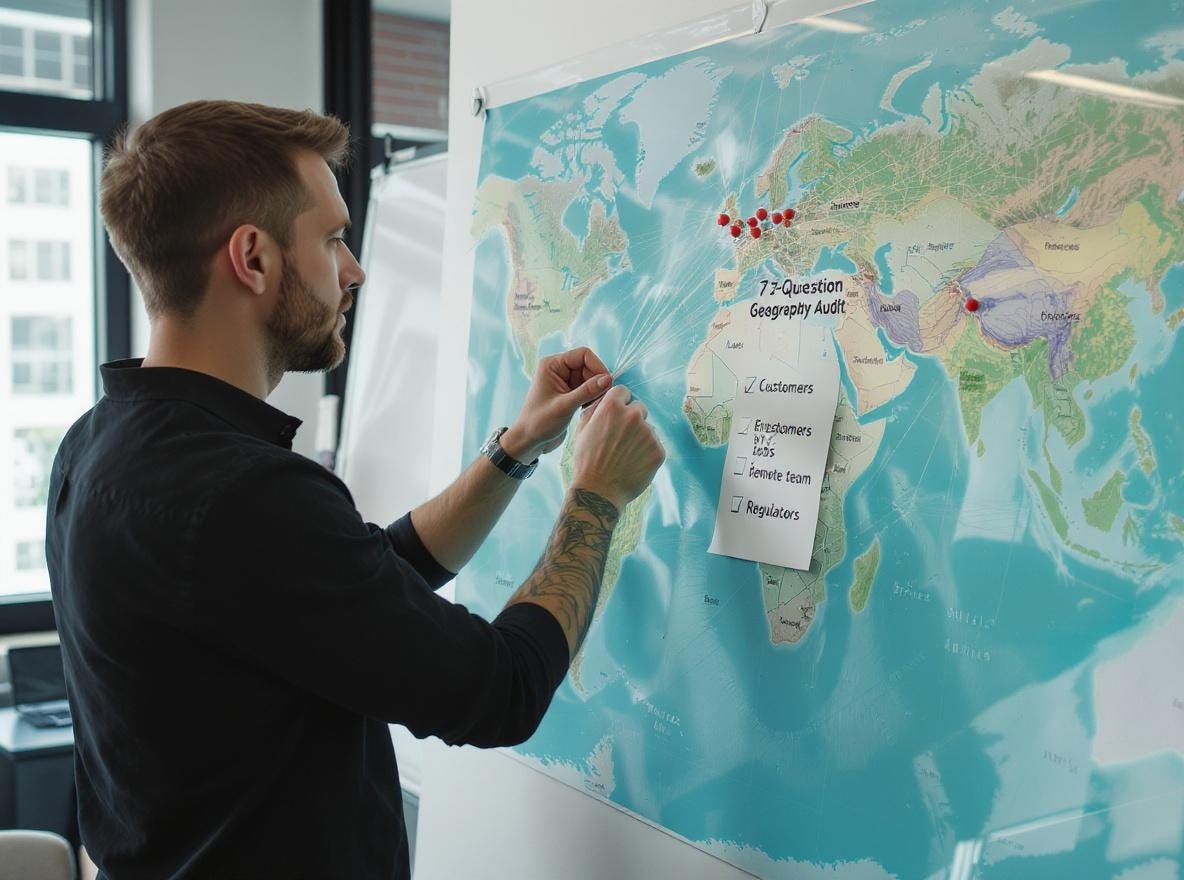
A 7-Question Geography Audit (Decide in a Week)
Use these thresholds to choose your setup for the upcoming 12 months:
Map your inputs:
Where does your domain knowledge sit? If it’s tied to a local workflow (oil & gas, maritime, clinical trials), stay close until PMF.
What’s your customer density? If 30% or more of ideal customer profile (ICP) companies cluster in one city/region, put sales/product discovery there.
What are the deal sizes? If average selling price (ASP) ≥$250k and cycles ≥6 months with 3+ signers, co-locate sales.
Check your constraints:
What stage are you? Pre-PMF: prioritize customer proximity. Post-PMF: optimize burn and talent. Pre-IPO: densify investor/analyst access.
Can you hire critical roles locally? If not within 90 days, consider a distributed approach for that function.
Do you have remote infrastructure? If not (no doc standards, no async rituals, no offsite cadence), expect delays. Don’t go fully distributed yet.
What’s your runway vs. burn? If it is less than 12 months, create a cost-efficient hub and schedule quarterly density weeks in target markets.
Choose deliberately, then review quarterly. Geography isn’t a label. It’s a lever.
What This Means for You
Geography used to be a filter. Now it’s a design choice.
The truth:
Domain knowledge sits where challenges exist.
Capital flows to great teams regardless of location.
Talent exists globally, but remote coordination requires infrastructure.
Cost structure matters, but lower burn trades off against speed and network access.
Some sales cycles require meetings in person.
The tradeoffs:
Emerging ecosystems give you opportunities but fewer peer networks.
Remote teams provide access to talent, but they involve greater coordination costs.
Co-location gives you speed, but it also increases costs.
Moving HQ gives you market access but disrupts the organization.
Geography isn’t dead, but it’s no longer in charge.
Your move: Use the 7-question audit. Map your domain knowledge, customer concentration, and burn rate.
Am I in the right place for the next 12 months — or am I just here because I began here?
The companies that win this decade won’t be in the “right” cities. They’ll be the ones who chose their geography as thoughtfully as their market.
__________
Want help pressure-testing your market fast? Wildfire Labs is inviting you to join the Great Plains Regional I‑Corps program (Lean Startup + customer discovery). You’ll get structured coaching, work through customer interviews, and your team may be eligible for a $2,000 completion grant (space limited). Learn more and Apply by Jan 18: https://forms.zohopublic.com/greatplainsicorpshub/form/ProgramApplication/formperma/nx1VEJtDHDIjraaF7e3pEPcUB_oZp3OCA7X3krRntkw (Select “DSU Regional I‑Corps Spring Cohort 2026.” Questions: info@gp-icorps.org)
Did this post resonate with you? If you found value in these insights, let us know! Hit the ‘like’ button or share your thoughts in the comments. Your feedback not only motivates us but also helps shape future content. Together, we can build a community that empowers entrepreneurs to thrive. What was your biggest takeaway? We’d love to hear from you!
Interested in taking your startup to the next level? Wildfire Labs is looking for innovative founders like you! Don’t miss out on the opportunity to accelerate your business with expert mentorship and resources. Apply now at Wildfire Labs Accelerator https://wildfirelabs.io/apply and ignite your startup’s potential. We can’t wait to see what you’ll achieve!
I’ve been contemplating this myself. Our business is in Oil/Gas/chemical processing etc. I currently live in south Florida migrated from my home country during covid. Florida was where my family/friend network live and needed that during covid.
Children are now settled in Fl and it’d be unfair to move them again. I’m going to treat it as my offshore rotation as I did in my bp days. Kids are grown up teenagers now.
This deserves to be more than a blog post: a quiz format, maybe? I was just thinking about this in regards to a company in Texas and wondering why they didn't move to to Maine where they would have gotten 30% more for their money via incentives. TBF, I don't know that Texas didn't give them money, but Insurance companies (imho) have more implied gravitas with the Maine label. Can your test also account for sentiment?