
The CPO Who Started Again
What 30 Years in Product Taught Me About Going Back to Zero

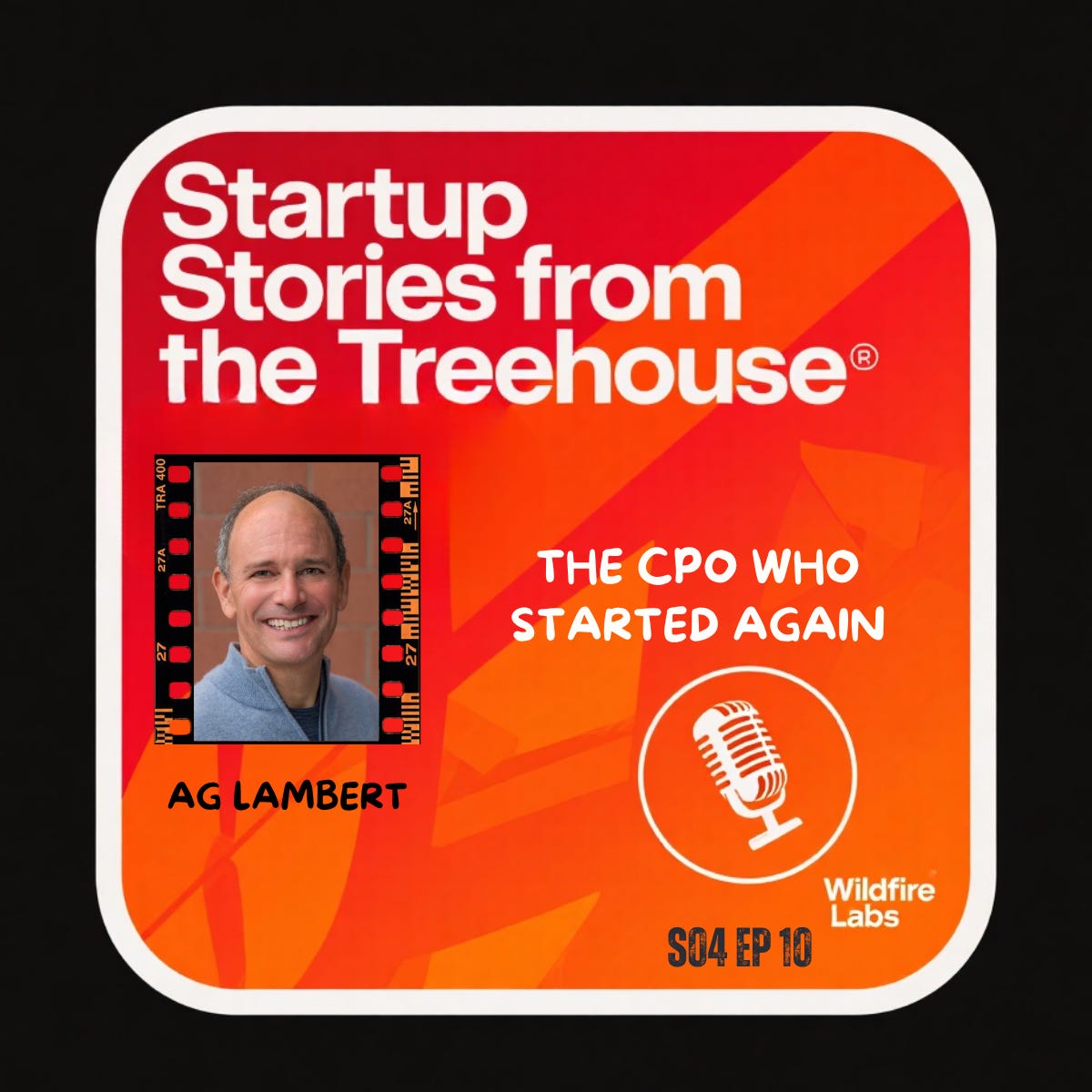
This week on Startup Stories from the Treehouse, I sat down with AG Lambert — former CPO, 30-year product veteran, and accidental solo founder. Here’s what was notable.
There’s a certain kind of founder who avoids the uncomfortable part.
They talk to a few potential customers who nod along and say “yeah, I’d use that.” The founder walks away thinking they’ve validated their idea — when really, they’ve only confirmed what they already believed.
In this week’s Startup Stories from the Treehouse, I spoke with AG Lambert — a product leader with three decades of software experience at Autodesk and Concur, and most recently Chief Product Officer at Navex. At Concur, AG grew an invoice product from $6 million to over $100 million in ARR. He encountered every version of this mistake, at every stage of company growth.
AG’s perspective is different right now. He’s not observing from the executive suite; he’s in it. After years leading large product organizations, AG walked away from the CPO title to start over. He is building a product alone, getting his hands dirty with AI tools he’d never touched, and rediscovering the experience of going from zero.
One of my favorite conversations was the one we had. It was honest, a little uncomfortable, and full of things I wish someone had known earlier. Whether you’re pre-revenue or nearing your first million, there’s something here for you.
AI Changed Everything. Except What is Important.
If you’ve spent time on LinkedIn lately, you’ve seen this take: AI will kill product management. AG has a detailed view.
“AI has changed two things: speed and access. But the fundamentals remain the same.”
He means that the core of great product management — understanding a customer problem deeply and translating it into a proposed solution — is unchanged. AI hasn’t touched that. It has compressed everything else. Market research, competitive analysis, writing requirements, prototyping — all move faster now.
But here’s the trap. If you use that speed to skip the customer understanding step, you’re building the wrong thing more quickly.
“You can have deep domain expertise and still have implicit bias. You think you know the answer. A structured interview — not just a conversation — creates a framework that removes some bias.”
There’s a difference between an interview and a conversation. A conversation reinforces your beliefs. A structured interview, with defined questions for multiple people, tells you whether your thesis holds up across a broader population. That’s the work most founders overlook.
The $100M Lesson No One Wants to Hear
When AG joined Concur’s invoice team, the product had around $5–6 million in ARR. It was underinvested. Customers were dissatisfied. The sales team didn’t want to touch it.
What was job one? Not a product overhaul. Not a new go-to-market motion.
“Find out what’s pissing off the customers and start fixing it. Show you care.”
That sounds embarrassingly simple. But it’s the step most growth-mode founders skip. They’re so focused on the next feature, funding round, and milestone that they forget to ask existing customers what’s broken.
After getting customers to a baseline of “not miserable,” the next unlock was segmentation. Concur had been selling invoice to large enterprise customers — the wrong fit. Big enterprises need full procure-to-pay systems. It wasn’t that. But for mid-market and SMB companies needing a clean, simple way to process AP and close their books, it was a perfect match.
“We weren’t trying to transform procurement. We aimed to help you get your paper processed and approved easily and efficiently.”
The sales team gained confidence from that clarity of positioning — knowing where you fit and where you don’t. Once salespeople realized an invoice deal could be two to three times larger than a travel and expense deal, momentum built.
The segmentation insight, honest positioning, and willingness to address the fundamentals took a neglected product from $6M to over $100M.
Road Test the Prototype Before You Assume It’s Ready.
If AG could give one piece of advice to a founder right now, it’s this:
Road test your prototype. Don’t wait for complete software.
“Test a prototype with customers. Don’t rely solely on your domain knowledge; it’s valuable but requires validation.”
This is harder than it sounds. Founders are afraid. They want one more feature before showing it to anyone. They want a cleaner demo. They want to be prepared.
But “ready” is a moving target that keeps you insulated from the one thing that would tell you whether you’re building something real. Feedback from ten customers with a scrappy prototype is worth more than six months of solo iteration.
AG is living this right now. As a solo builder, he’s taken his early product to people he’s worked with for thirty years. The feedback has been challenging — questions like “how are you tying this to a customer outcome?” that forced him to rethink the framing.
“It’s both emotional and data-driven. You need someone to tell you if you’re crazy or if this is valuable.”
The Loneliness Aspect Nobody Talks About
Transitioning from a large organization to building on your own means losing essential infrastructure you relied on.
Not just the engineers, designers, and go-to-market team, but also the intellectual infrastructure. The people who push back on your ideas before they become poor choices. The ambient sharpening from being surrounded by smart people who disagree with you.
AG described this as one of the more challenging parts of going solo. “The emotional support has been harder,” he said.
His solution has two parts. First, he relied on AI as a genuine thought partner — not as an oracle, but to bounce ideas off, iterate, and stress-test assumptions. “This would be much harder without AI,” he said.
Second, he’s been reaching out to his network: former colleagues, startup people, and those at big companies. Not just for feedback but for human connection to avoid isolation.
If you’re building alone, this part isn’t optional. The intellectual isolation is real and compounds over time. Find your people. Create feedback loops. Build a network that tells you hard truths.
What Product Management Will Look Like in Five Years
AG’s vision for the discipline’s future is worth considering if you’re an early-stage founder wearing the product hat.
Supporting functions like data processing, writing PRDs, competitive analysis, and drafting requirements will increasingly be handled by AI. This doesn’t threaten product managers; it creates space.
Space to spend more time with customers. Space to iterate faster. Space to actually do the thing that drives everything else: developing a deep understanding of the problem you’re solving.
“Strip the job down to its fundamental value. You understand the customer’s problem and can propose solutions. That is all.”
That’s true for a solo founder building their first product and a CPO managing a 50-person team. The tools, market, and speed change, but the job — listening to customers, understanding their needs, and translating that into something valuable — never does.
The One Thing to Do Differently Today
If you’re an early-stage founder, here’s what to take from this conversation:
Stop building toward certainty. Start building toward feedback.
Replace your next feature work sprint with structured customer conversations. Not casual chats for validation — actual interviews, with defined questions, across multiple people who have no obligation to be kind to you.
Show your current prototype to five people who will question your thinking.
If you’re building alone, make one call this week to someone who will challenge your ideas.
The fundamentals of building something people want haven’t changed. You just have to execute them.
AG Lambert has spent 30 years in product, including 11 years at Concur where he grew the invoice product from $6M to $100M+ ARR. He is now building independently and can be found on LinkedIn.
MR.TODD has done a whole series of excellent interviews with top Technology / AI founders/Professionals/ startups, researchers and engineers, and MR.TODD’s this week on Startup Stories from the Treehouse,interviews—AG Lambert — former CPO, 30-year product veteran, and accidental solo founder.
“The CPO Who Started Again” is a great distillation of MR.TODD conversation that helps me and the readers understand modern AI models, how they are built, where they are headed, and why they are important.
At a moment when every software investor, operator, and board member is asking some version of “wait,Product Management is dead now,?” AI will kill product management. AG has a detailed view.There’s only one test relevant for an artifact about AI which means that the core of great product management — understanding a customer problem deeply and translating it into a proposed solution — is unchanged. AI hasn’t touched that.
“AI has changed two things: speed and access. But the fundamentals remain the same.”MR.TODD findings resonate and so does AG Lambert answer which is much more useful.
I conclude after that it’s definitely getting repriced, rethought.MR.TODD post reframes —“Actual value capture”—The One Thing to Do Differently Today—
If you’re an early-stage founder,—Stop building toward certainty. Start building toward feedback.The fundamentals of building something people want haven’t changed. You just have to execute them.