
Why Your Customer Data Is Lying to You
Five lessons on asking better questions, automating smarter, and building outside Silicon Valley.

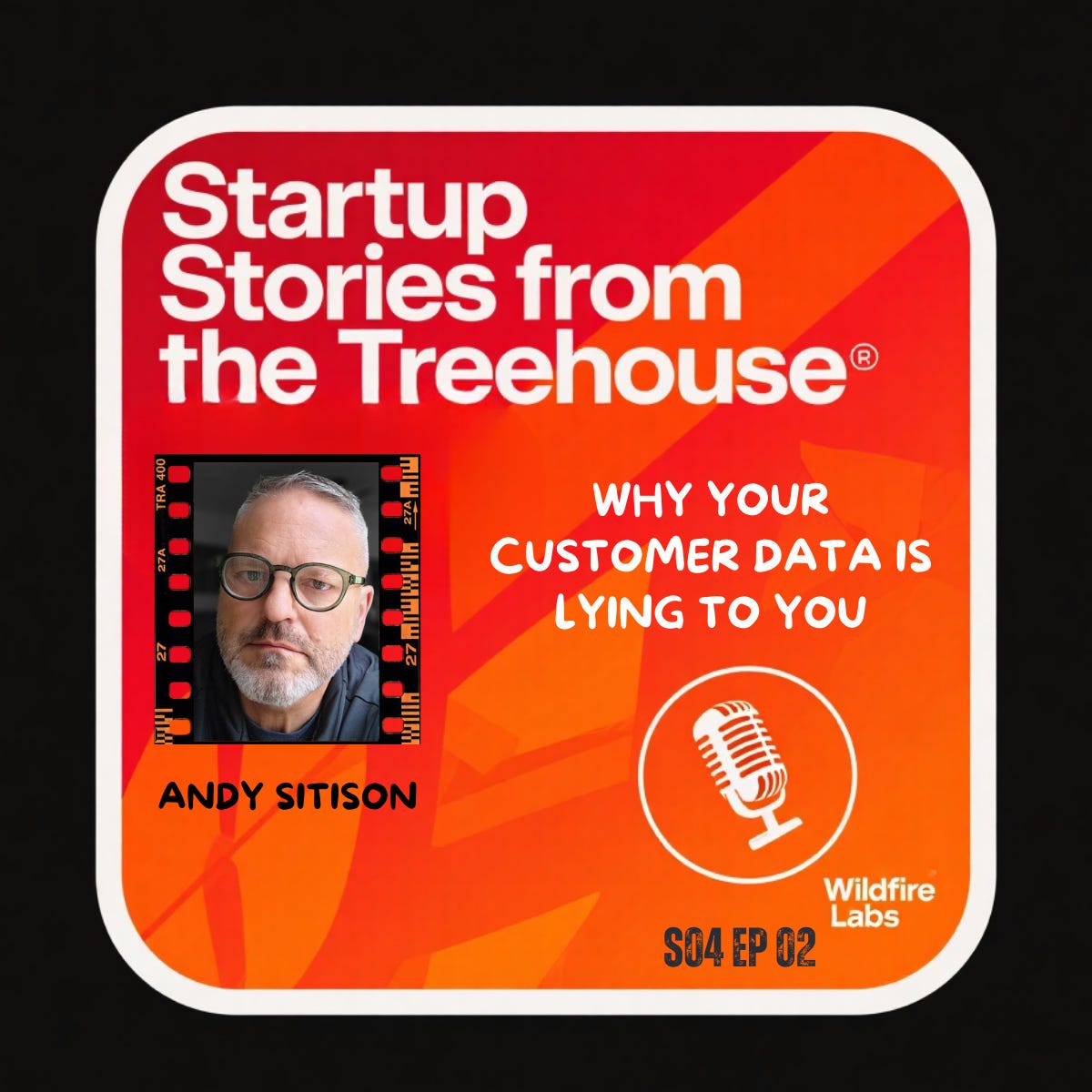
This week on Startup Stories from the Treehouse, I spoke with Andy Sitison from Share More Stories. After fifteen years as a systems integrator, he taught himself AI and machine learning during a sabbatical. Now he’s building a company that uses AI to analyze long-form customer stories, helping organizations move beyond traditional surveys to understand the reasons behind customer behavior.
Here are five insights from our conversation: why surveys miss the real story, what 30–40% automation looks like, how Andy builds “cellular AI” that stays in context, the 2–3 year reality of services-to-product transformation, and how to stay sharp when building outside major tech hubs.
1. Ask “Why” Before You Optimize “What”
Most founders optimize features before understanding motivation. They ask “what” questions (features, price points, colors) and get exactly what those prompts can see. But surveys only answer the questions you already thought to ask.
“Surveys help answer your questions. We help you determine the right questions to ask.”
A sports drink company doesn’t ask “What do you think of our product?” Instead, they ask “Why do you exercise?” The answers segment for identity, joy, health, or weight loss—distinct motivations that require different positioning.
The trust factor. To get authentic answers, Andy’s team designs for candor: anonymous usernames, human validation, and a hard rule—never connect identities to individual stories. “How often have you given honest feedback in a corporate survey when you weren’t sure if your boss would see it?”
How to implement this:
This week, talk to 5–10 customers. Replace “What do you think?” with “Why did you hire our product?” and “What were you trying to become or avoid?”
Record conversations and listen for emotional language—words like “frustrating,” “exciting,” and “relief.”
Design for candor: use anonymous intake, validate humans, and state who sees what. Never link stories to identities.
Identify the underlying job associated with the request.
Reframe your value proposition around motivation, not functionalities.
2. Automate 30–40% and protect the 10% that secures deals.
Every founder thinks AI will automate 80% of their business overnight. Andy’s more realistic: “I’d love for it to be higher than 30–40%, but I’m an automation guy… It doesn’t happen.”
Share More Stories automated data collection and scoring with machine learning models. They kept humans in interpretation because customers pay for insight, not just screens.
Key insight: automate repetitive, low-value work, but keep humans where judgment and expertise count.
The 30–40% automation audit:
Is it identical each time? (Data entry, report formatting) → Automate initially
Does it require no judgment? (Confirmation emails, scheduling) → Automate second
Do customers pay for human insight here (Strategy, recommendations)? → Keep human.
Would automating this hurt trust? (Client communication, quality control) → Keep human
How to apply this:
Audit your workflow this week. List every task and mark it “automate,” “keep human,” or “unsure.”
Start with the most challenging, low-value 20%, which usually consists of data entry or formatting.
Preserve human interpretation in customer-facing interactions, as this is where trust and value are found.
Before automating anything customer-facing, ask: “Would I pay for the automated version, or am I paying for the person doing it?”
3. Build “Cellular AI” for Context, Not Generalization
Tools like ChatGPT are powerful, but they lack specificity.
“It’s about context. Most failure points happen when it’s lost where it is.” They deploy “cellular AI”: distinct agents with their own instructions, models, and data scopes, each locked to a single job.
Andy uses RAG (Retrieval-Augmented Generation) plus custom instructions. But you need guidelines beyond pointing AI at data.
When context drifts, AI fails. Given participant data with multiple status fields, “How many participants?” returned 45, then 300, then something else—the model kept choosing different cross-sections.
The fix? “Be straightforward. For accuracy, be precise.”
Be explicit and firm with instructions. Correct hallucinations decisively—treat it like a junior analyst with responsibility.
How to apply this:
Instead of building a horizontal AI tool, pick one narrow use case and make it outstanding at that one thing.
Analyze customer feedback for [specific product]. Reference stories in [this dataset]. Your goal is [specific outcome].
Define a source of truth for each metric (e.g., “participant = status=ACTIVE in table X, field Y”).
Test rigorously. Ask the same question five ways and check for consistency.
If necessary, build multiple specialized agents instead of one general-purpose tool.
Add red-line rules to prevent drift, such as “Never count participants with status ≠ ACTIVE” or “Never infer sentiment from fields outside schema A.”
Treat AI like a junior analyst: give clear instructions, check its work, and correct it when it hallucinates.
4. Services → Product Takes 2–3 Years (Choose a Path and Sequence It)
Andy was honest: “We’d love to be a SaaS model, but attempts to speed that up almost bankrupt us.”
Share More Stories started as services. It is layering product over 2–3 years, staying “friends and family funded” to avoid scaling too quickly.
Three paths forward:
Path 1: Product-Enabled Services Choose this when customers pay for expertise and the workflow has 30–40% automatable tasks.
Path 2: API-First / Middleware Build your core capability as an API that integrates into existing tools. Choose this when you solve one specific problem effectively and customers appreciate their tools.
Path 3: Domain-Focused Consulting Choose this when you have deep expertise and the problem is significant and infrequent.
How to pick: Look at your unfair advantage. Is it process + domain expertise? Technical capability? Deep vertical knowledge?
How to apply this:
Be honest about your 2–3 year timeline. Don’t let VC pressure lead to premature scaling.
Use service revenue to fund product development, not external capital.
Choose your path based on your unique strengths, not what VCs want to fund.
Watch for customers. That’s your signal for what to productize first.
Model 6 quarters with one product layer per quarter:
Q1: ship intake automation will displace 20% manual scoring and generate +$15K cash.
Q2: add sentiment dashboard, reduce reporting time 40%, +$25K cash.
Q3: launch API for existing tools, enable 3 integrations, +$40K cash
Calculate actual service margins vs. realistic product margins. “Lower scale, higher margin” can outperform “venture scale, commoditized.”
5. Stay Alert When You’re Out of the Room
Andy (Richmond, Virginia) and I (Rapid City, South Dakota) chose to build outside major tech hubs. He refused a “move to SF” mandate and left. The challenge isn’t access to talent or technology—it’s sharpening. When you’re the most knowledgeable person in the room, you stop growing.
“I’ll be in the audience of a local AI meeting. They got mics and acting important. And I’m like, none of you know anything about what you’re talking about. I’m the only guy in the room that does. I’m sitting down here not saying a word.”
The 90-day sharpening plan:
Month 1: Build Your Board of Rivals Identify 5–7 founders 1–2 years ahead solving similar problems. Reach out with specific value: “I’m studying [problem]. Saw you tackled this. Can I interview you for 20 minutes?” Create a private group for this crew.
Month 2: Schedule Monthly 90-minute deep-dive Sharpening Sessions where each person presents their hardest current problem and the group pressure-tests assumptions. Prompts: “What am I not seeing?” “Who’s solving this better?” “What question should I be asking?”
Month 3: Invest in Concentrated Learning. Attend 1–2 conferences per year in major hubs. Book 8–10 coffee meetings during each trip. Follow up within 48 hours with something valuable. Budget $5–10K/year—treat as research and development.
How to apply this:
Identify 5 founders who are 1–2 years ahead this week and reach out.
Schedule your first sharpening session this month.
Book one trip to a major hub this quarter and schedule 10 coffees in advance.
Make it reciprocal: share what you’re learning, make introductions, provide feedback.
Andy said, “Invest locally, meet someone, walk the street, shake a hand—don’t do it all in tech. Your job isn’t that important. Those that take time for others are better grounded, advance better, and have a greater impact on the world.”
Final Thought
Andy’s journey from systems integrator to AI founder wasn’t about timing or funding. It was about deep domain expertise, continuous learning, and patient execution. He took 2–3 years to build what VC-backed companies try to build in six months.
Winning companies aren’t always the fastest or best-funded. Sometimes they’re the ones that understand their customers well enough to ask more insightful questions.
Your 24-hour challenge: Pick your best customer. Call them today. Don’t ask what they think of your product. Ask why they hired it. Record that conversation. Listen to it twice. You’ll discover something you’re not building for.
_________
Did this post resonate with you? If you found value in these insights, let us know! Hit the ‘like’ button or share your thoughts in the comments. Your feedback not only motivates us but also helps shape future content. Together, we can build a community that empowers entrepreneurs to thrive. What was your biggest takeaway? We’d love to hear from you!
If you’re a software founder looking to turn your idea into a successful startup, Wildfire Labs can help you get there in just 6 months. Check out our program at https://wildfirelabs.io to learn more about our proven process, expert mentors, and the development resources we provide to help you build and scale your company. If you have any questions or need assistance with your startup, don’t hesitate to reach out to us at info@wildfirelabs.io.
MR.TODD GAGNE’s article is probably the First ever article questioning—Why Your Customer Data Is Lying to You—and,in his answer MR.TODD shares deep insights from his exclusive talk with Mr. Andy Sitison from Share More Stories.
After all,we all have servers brimming with isolated datasets that languish due to the absence of the narrative architecture necessary to create essential utility for adoption.And,this is where MR.TODD’s WISDOM PERALS not only resonate with me—MR.TODD’s words—Pick your best customer. Call them today. Don’t ask what they think of your product. Ask why they hired it. Record that conversation. Listen to it twice. You’ll discover something you’re not building for—now are on my Top to-do-list.
Substack deserves praise for always empowering me and readers through insights from renowned Startup Consultant MR.TODD of WILDFIRE.